
Innovative solutions
Developing a novel AI-assisted theranostic approach for bladder cancer lesions
The adoption for clinical applications of this new device will reduce the frequency of the bladder tumour relapse and the number of patients with relapsing tumour, with a drastic positive impact on the quality of life of patients while reducing the social cost of the management of patients.
Furthermore, the success of PHIRE’s developments will pave the way for similar theranostic applications targeting lesions smaller than 1 mm in other hollow organs of the human body.
In addition, PHIRE innovative solutions will also be applicable to other markets, such as that of photoacoustic and diagnostic imaging, gold nanoparticles, cystoscopy and medical software.
Gold nanorods for cancer detection
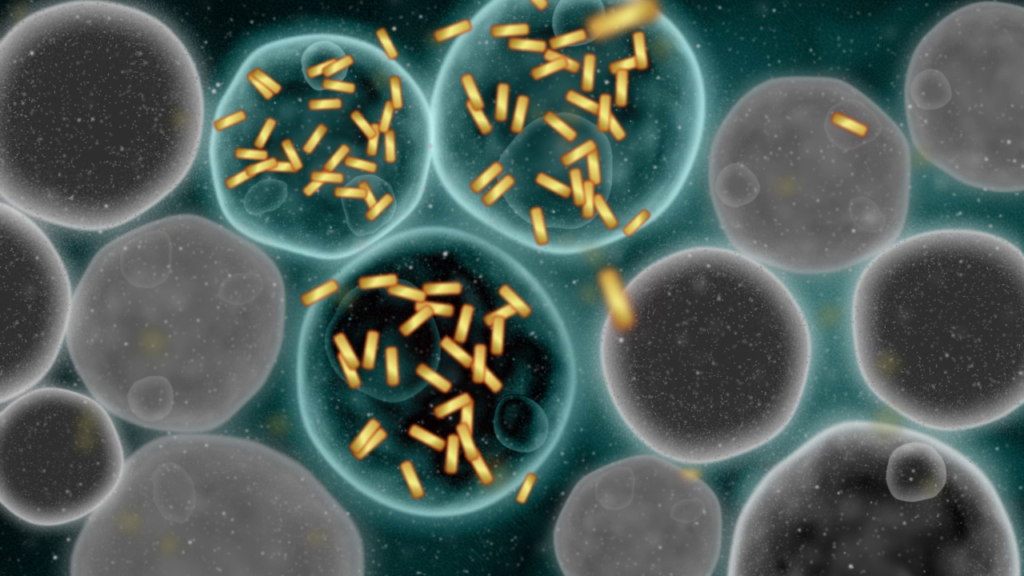
Nanorods are small particles that have a nanometric size, made of gold and the shape of a cylinder. This allows the possibility to interact with light, and, in particular, with light that has no interference with the body absorption. This allows gold nanorods to be used in cancer detection and treatment, exerting some effects by laser irradiation.
However, gold nanorods, even if they are synthetised since many years, are not nowadays utilised in cancer treatment due to lack of reproducibility in synthesis and due to difficulties in scale up of their synthesis. That is something that must be addressed before producing nanorods for real cancer treatment.
Gold nanorod production
PHIRE has worked intensively on optimising critical parameters such as the preparation and storage of the seed solution, the addition of the growth solution, reaction conditions like peak temperature and time, and, most importantly, purification.
Purifying gold nanorods at this scale remains a major hurdle, as very few examples exist of nanostructured materials for diagnostic imaging being produced at such high volumes.
Certification and regulatory requirements
While progress can be made in addressing the synthetic chemistry, another significant challenge lies in scaling up production to meet the rigorous certification and regulatory requirements needed for clinical use. This requires a strong collaboration between industrial chemistry experts, companies, and regulatory bodies to navigate the necessary steps.
The PHIRE project is focused on overcoming these obstacles by improving the reproducibility of gold nanorod production and enabling reliable large-scale manufacturing.
These advancements are crucial for moving the technology closer to clinical use in cancer detection and therapy.
Advancing photoacoustic imaging
Photoacoustic imaging (PAI) represents a significant step forward in medical and scientific imaging by combining the strengths of optical and ultrasound technologies. This innovative technique uses a safe, non-ionising laser to illuminate tissues, causing specific molecules, known as chromophores, to emit ultrasound waves. These waves are then captured to create detailed images.
Unlike traditional ultrasound, which relies solely on sound waves, PAI benefits from the high contrast provided by optical absorption and the deeper tissue penetration of ultrasound. Furthermore, it allows for real-time imaging without the need for contrast agents, making it a versatile and minimally invasive tool.
This unique combination of features enables PAI to produce clearer, deeper, and more informative images than many conventional methods, opening new opportunities for both clinical applications and research.
Enhancing precision in photothermal therapy
Photothermal therapy uses continuous laser irradiation to destroy cancerous tissue. A prediction map shows where the tumour is located, its size, and how long it needs to be irradiated to ensure complete eradication. This timing is calculated using complex mathematical models that simulate heat generation and transfer in tissue, as well as cell death due to rising temperatures.
However, these models are computationally heavy, often involving over a million equations, and require hours to solve, making real-time clinical application impractical.
To overcome this, the PHIRE team applies machine learning algorithms. By generating synthetic data from numerous scenarios (e.g. tumour size, position, laser power), they train AI models to rapidly estimate the ideal irradiation time for each patient. This enables clinicians to tailor treatment precisely and adjust the surrounding margin of tissue damage as needed, maximising tumour removal while protecting healthy tissue.

